As the Philippines builds out its digital infrastructure, the growth of data centers is placing increasing attention on the systems required to keep these facilities operating efficiently and reliably.
The U.S. International Trade Administration (ITA) describes the Philippine data-center market as experiencing robust growth, driven by increasing demand for cloud computing, digital services, and data-sovereignty requirements. The agency also identifies local and international participants including ePLDT, Equinix, Digital Edge, and STT GDC Philippines.
Energy is another important part of the country’s evolving AI-infrastructure landscape. The Department of Energy has highlighted the need for secure and increasingly sustainable energy resources as AI and data-center infrastructure expands.
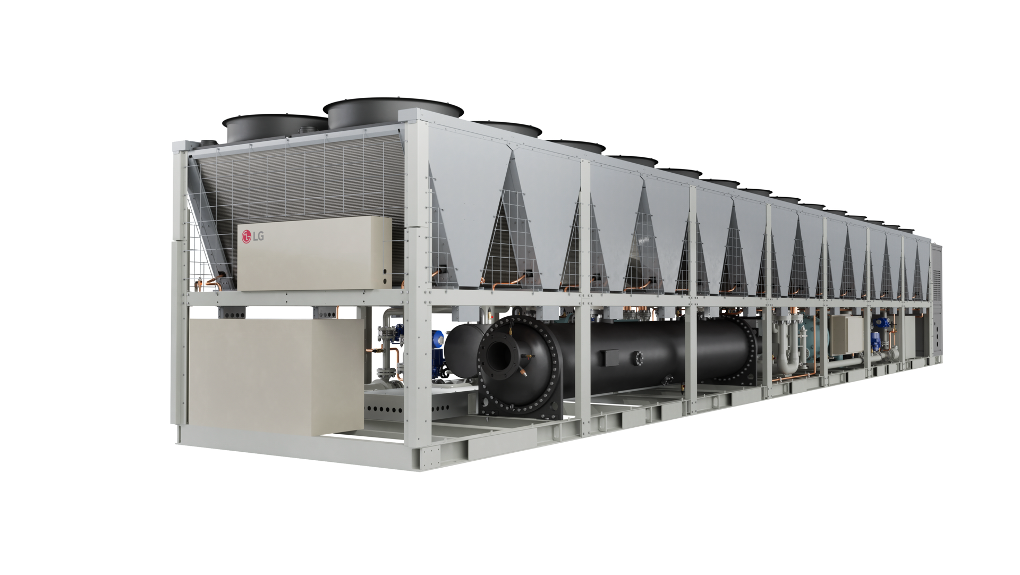
Against this backdrop, LG Electronics (LG) has launched its high-efficiency, highly reliable Air-Cooled Centrifugal Chiller (ACC), designed to meet the increasing cooling demands of AI data centers (AIDCs). The solution is designed to improve energy performance and maintain cooling continuity, further strengthening LG’s data-center cooling portfolio. With cooling capacities ranging from 480 to 600 RT per unit, the chiller can be configured for AIDCs with varying cooling requirements.²
High-Efficiency Cooling for Demanding AI Workloads
At the core of the new LG Air-Cooled Centrifugal Chiller is an oil-free magnetic bearing centrifugal compressor. By using magnetic force to suspend the rotating shaft without physical contact, the design eliminates the need for lubricating oil, reducing mechanical friction losses and improving compression performance.
The chiller also incorporates refrigerant free-cooling technology, which uses cool outdoor air to lower the compressor cooling load. Unlike conventional free-cooling systems, it circulates refrigerant directly without an intermediate heat exchanger and does not require glycol, minimizing heat and pressure losses while simplifying maintenance.
Based on LG’s internal simulation, refrigerant free-cooling can consume approximately 30 percent less energy annually than waterside free-cooling.³ LG’s series counter flow (SCF) technology also helps maintain balanced operation by distributing the cooling load among the compressors.
Designed for Cooling Continuity and Flexible Management
Along with energy efficiency, maintaining consistent cooling is critical for the operation of increasingly demanding AI infrastructure.
LG’s new chiller incorporates a gap sensor into its magnetic bearing system to precisely detect the rotation axis and enable accurate control. Machine-learning capabilities allow the system to adapt to operating patterns, helping reduce surges.
During a power outage, an integrated uninterruptible power supply (UPS) provides emergency power, allowing the shaft to stop safely and lowering the potential for bearing damage. Once power is restored, the chiller’s fast recovery feature can restore full cooling capacity within three minutes.¹
LG is also strengthening cooling-system control through Data Center Cooling Management (DCCM). The software enables integrated monitoring and data-driven control across complex cooling infrastructure, including Coolant Distribution Units (CDU), Computer Room Air Handlers (CRAH), and Air-Cooled Centrifugal Chillers.
DCCM supports continuous operation through early anomaly detection and virtual sensor-based diagnostics. It contributes to risk management through predictive maintenance, while real-time optimization based on IT workloads can improve operational efficiency.
Proprietary Core Tech and Globally Validated Performance
LG’s proprietary Core Tech encompasses key chiller components including compressors, motors, inverters, and magnetic bearings. LG develops and manufactures these components in-house before integrating them into complete systems to optimize overall performance, improve parts availability, and shorten maintenance response times.
Globally, the performance and reliability of LG chillers are validated through certifications. LG chillers and testing facilities are certified in accordance with standards established by the Air-Conditioning, Heating, and Refrigeration Institute (AHRI), while LG’s air-cooled chillers have received the AHRI Performance Award for nine consecutive years.
LG chillers also meet major global standards and certification requirements, including American Society of Mechanical Engineers (ASME) requirements for pressure vessels, Electrical Testing Laboratories (ETL) requirements for electrical safety in North America, and Conformité Européenne (CE) requirements covering safety, health, and environmental standards in Europe.
Further expanding its data-center cooling solutions portfolio, LG will showcase its modular hydronic cooling solution at Data Centre World Asia 2026, to be held September 29 to 30 at Marina Bay Sands in Singapore.
The solution integrates key components, including chilled-water pumps and a Thermal Energy Storage (TES) buffer tank, into a standardized module. Factory prefabrication and assembly are designed to simplify on-site installation, while LG’s prefabricated modular chiller design provides flexibility for fast and scalable deployment as AIDCs expand their capacity.
“As AI data centers become increasingly dense and heat-intensive, energy-efficient, reliable cooling is more critical than ever,” said James Lee, president of the LG ES Company. “With our Core Tech and data center cooling expertise, we will continue to expand our portfolio of solutions to meet these evolving requirements.”
¹ Result may vary depending on test conditions.
² Cooling capacity figures are based on data center operating conditions, with chilled water inlet/outlet temperatures of 28/20°C and an ambient temperature of 40°C. Actual cooling capacity may vary depending on installation and operating conditions.
³ Based on LG’s internal simulation of a single 1,750 kW unit operating at 100 percent cooling capacity under climate conditions in the Seoul metropolitan area. Annual energy consumption was calculated at 1,479,655 kWh for hydronic free-cooling and 1,044,824 kWh for refrigerant free-cooling. Actual energy consumption may vary depending on installation and operating conditions.
About LG Electronics Eco Solution Company
The LG Eco Solution Company (ES) offers advanced air conditioning solutions, including chillers, for diverse sectors and climates. Committed to exceptional HVAC performance, the ES Company aims to enhance indoor comfort and well-being with innovative air care products. Leveraging deep industry expertise, it offers digitalized HVAC solutions designed for better life. As a trusted partner, the company integrates cutting-edge technology into daily operations while offering ongoing support. For more information, please visit www.LG.com/global/business/hvac.

Karina is not your ordinary supermom. She juggles her time bonding with her three amazing kids while being in the loop on the latest happenings in the tech and lifestyle scene. Follow me on Instagram (@digitalfilipina) regularly visit www.digitalfilipina.com for daily dose of updates not just for moms but for everyone!